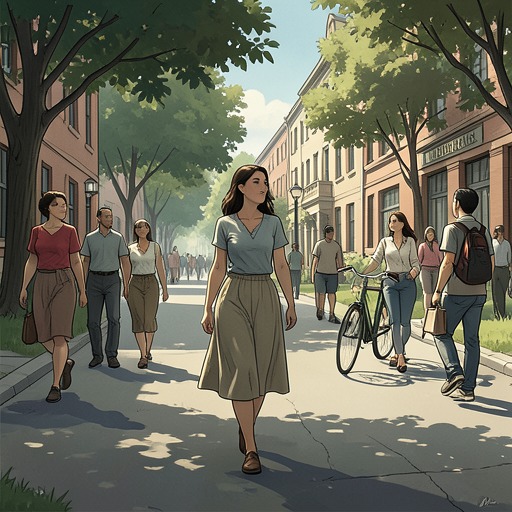
Auden’s quest
Along for the RideAuden’s quest is Eli’s name for Auden’s search for things she feels she missed growing up, and for the late-night experiences they undertake together. Its significance lies in the change of frame: what Auden had thought was merely hanging out becomes an intentional, shared attempt to recover lost possibilities, one activity at a time.
Naming the Search
The idea takes shape during an after-hours grocery run. While Eli checks the milk’s expiration date, Auden lists experiences she thinks she should have had during her first eighteen years: slumber parties and breaking curfew on a Friday night. Eli adds riding a bike, an activity he has raised with her before. Auden challenges his persistence about the bike, showing that the search begins not as a plan she has already accepted but as a subject they are negotiating together.
At Park Mart, just after four in the morning, Eli argues that being there at that hour counts as an experience in its own right. Auden considers whether the activities she believes she missed might be overrated, and whether there is any point in trying them now. Eli answers that an activity need not have a point or reason; sometimes it is simply something a person has to do. The exchange shifts the question from whether the past can be repaired to whether Auden can still choose to try. His answer offers no promise that an experience will compensate for what came before; it makes trying worthwhile without requiring that it do so.
From Hanging Out to a Quest
Auden later asks Eli what he means by calling their search a quest. At a red light, with no other cars in sight, he explains it as looking for something lost or needed, comparing the idea to the searches in Lord of the Rings and Star Wars. Auden had understood their outings as killing time. The new term gives their companionship a direction: not toward a clearly specified prize, but toward experiences she believes may have been missing from her life.
The label also carries a note of play. Eli jokes that if Auden does not want to call it a quest, she can call it chicken salad. Auden admits that she likes the idea of searching for something lost or needed, perhaps both. The joke does not cancel the earnestness of the definition. Instead, it lets the two of them treat Auden’s sense of lack seriously without making their plan solemn or turning it into a formal program.
Their conversations repeatedly return to time: what lies ahead, including college, and what lies behind, including childhood. The late hour gives those discussions a different weight from ordinary daytime conversation. Auden observes that, since their first night out together, they have spent the hours between other people going home and sunrise talking, sometimes seriously and often not. Night stretches and compresses time at once; what they say and do feels enlarged by the darkness. Eli’s claim that a happy childhood is not necessarily out of reach becomes the idea behind their search, rather than a guarantee that the past itself can be changed.
A Routine of Small Attempts
Over the following weeks, the quest becomes part of a regular arrangement. Auden sleeps in the mornings, works in the evenings, and spends her nights with Eli. She no longer has to pretend their meetings happen by accident: after work they meet at Gas/Gro, where coffee and whatever else they might need help them plan the evening. The outings include errands and eating pie with Clyde, as well as working through the quest one item at a time.
That gradual rhythm matters. The quest is not presented as one decisive expedition with a single endpoint; its form is a series of ordinary choices made together. The places and activities vary, while the repeated planning gives the nights continuity. Eli’s role is active but not that of a strict instructor: he suggests activities and interprets them as rites of passage, while Auden asks whether they are necessary and decides how to respond. Their shared search makes room for both his encouragement and her uncertainty.
The Club as a Threshold
One night, the pair stand outside Tallyho, a club Leah likes. Auden questions whether entering is something she needs to do. Eli says that going to a club is a rite of passage and adds that choosing a bad club earns extra points. The idea of the quest therefore includes deliberately trying an experience for its place in the search, not because Auden has already decided she will enjoy it.
The attempt meets an immediate obstacle: the bouncer says that entry requires identification, and Auden worries as Eli presses their case. Eli promises that they do not want to drink or stay long, setting a limit of five minutes, then tells the bouncer that their purpose is a quest. The bouncer asks what kind of quest. The available scene ends at that question, leaving the outcome of this effort unresolved. As a small episode, it captures the concept’s method: an activity is proposed, Auden hesitates, and Eli tries to make room for an attempt by giving it a name. The quest does not erase the years Auden feels she missed; it converts that feeling into a continuing practice of doing things now.